PISA 2025: Beyond the rankings
ACER news 17 Sep 2026 6 minute readEducation experts gathered in Melbourne to examine what the latest PISA results mean for Australian education, and how evidence can be used to support improvement.
The release of the latest Programme for International Student Assessment (PISA) results made headlines around the world. But at a special event in Melbourne, education leaders were urged to look beyond rankings and focus on what the evidence can help systems, schools and teachers do next.
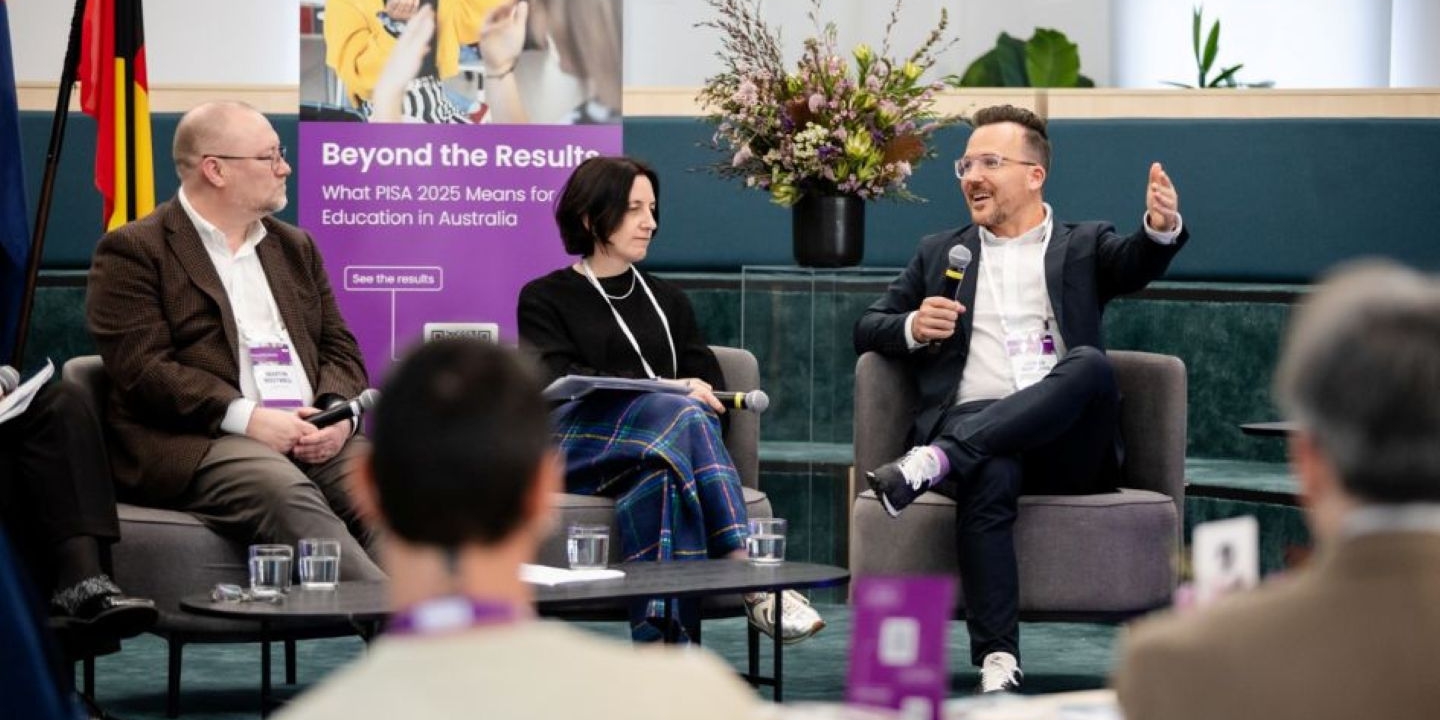
Beyond the Results: What PISA 2025 Means for Education in Australia was hosted by the Australian Council for Educational Research (ACER) in partnership with the University of Melbourne at the Victorian Academy of Teaching and Leadership. Held the day after the OECD-led release of the first PISA 2025 reports, the event brought together researchers, policymakers, system leaders and educators to discuss what the results mean for Australian education.
Opening the event, ACER CEO Lisa Rodgers PSM said PISA should not be treated as a league table, but as a tool for learning. ‘It’s about what we choose to do with PISA that matters, because data on its own changes nothing. Only decisions change things,’ she said.
‘The purpose of PISA is not to tell us where we are. It is to help us decide where we go next.’
More than 760,000 students internationally took part in PISA 2025, representing around 33 million 15-year-olds from 91 countries and economies. In Australia, more than 14,600 students from 766 schools participated in the assessment, which measured science, reading and mathematics, as well as the innovative domain Learning in the Digital World.
Lisa told attendees that while Australia continues to perform strongly by international standards, the most useful questions sit below the headline figures. A ranking can show where a system stands relative to others, she said, but it does not explain ‘why performance is changing or what educators and decision-makers should do on Monday morning.’
OECD Director for Education and Skills, Professor Andreas Schleicher, provided a global perspective in a video presentation, highlighting that education outcomes are shaped not only by economic circumstances, but by policy choices, classroom practices and the support students experience at school.
ACER’s Dr Eveline Gebhardt, who led the review of the Australian results, said Australian students performed above the OECD average and did particularly well in Learning in the Digital World. She also pointed to the need to examine longer-term trends in science, reading and mathematics, and to use the data to understand where support is most needed.
Evidence into action
University of Melbourne Laureate Professor Emeritus John Hattie said Australia’s results were cause for both celebration and serious investigation. He described Australia’s position among the stronger performing systems as significant, while calling attention to the conditions that allow excellence to be spread more consistently.
‘We are surrounded by excellence in our education system, we just need to scale it up,’ Professor Hattie said, calling for great teaching and learning for every student ‘by design, not by chance’.
Two panel discussions explored the implications of the results from global and local perspectives. Global trends and diverse perspectives considered what Australia is doing well and what can be learned from other education systems, while Local expertise and using evidence focused on the barriers and enablers to better use of evidence in schools, particularly when research already offers strong insights into what improves learning.
Speakers and panellists included:
-
Professor Pamela Snow - Distinguished Professor (Cognitive Psychology), School of Education, La Trobe University
-
Professor Martin Westwell - Chief Executive, Department for Education South Australia and Board Director, ACER
-
Dr Jordana Hunter - Program Director, Education, McKinnon
-
Dr Jonas Bertling - Research Director, Implementation and Reporting, ACER
-
Rachel Gore - Leading Teacher Curriculum, Albert Park College
-
Professor Therese Hopfenbeck - Professor in Educational Assessment and Head of School of Learning Sciences, Faculty of Education, University of Melbourne
-
Dr Goran Lazendic - PISA International Survey Director, ACER
-
Dr Sally Larsen - Senior Lecturer, School of Education, University of New England
Reflecting after the event, ACER Research Director Dara Ramalingam said a recurring theme was that assessment results only have real impact when teachers, curriculum developers, policymakers and researchers engage with the findings and consider what they mean for practice.
Senior Research Fellow Greta Rollo said the findings also highlighted the long-term nature of educational progress. As a researcher in early childhood, she described the PISA results as ‘the mature seedlings of the seeds of learning planted over 10 years ago’.
For educators and policymakers, the event reinforced that PISA is not an endpoint. The true value of PISA lies in the conversations, decisions, and actions that follow.
Watch the full event at Beyond the Results: What PISA 2025 Means for Education