Evidence to strengthen early literacy at scale in Cambodia
Research 20 Jul 2026 6 minute readAs Cambodia prepares to expand its Early Grade Learning package, ACER has led an important pilot study with the Ministry of Education, Youth and Sports (MoEYS) to pinpoint what is working in classrooms, what needs strengthening, and how evidence can guide system improvement.
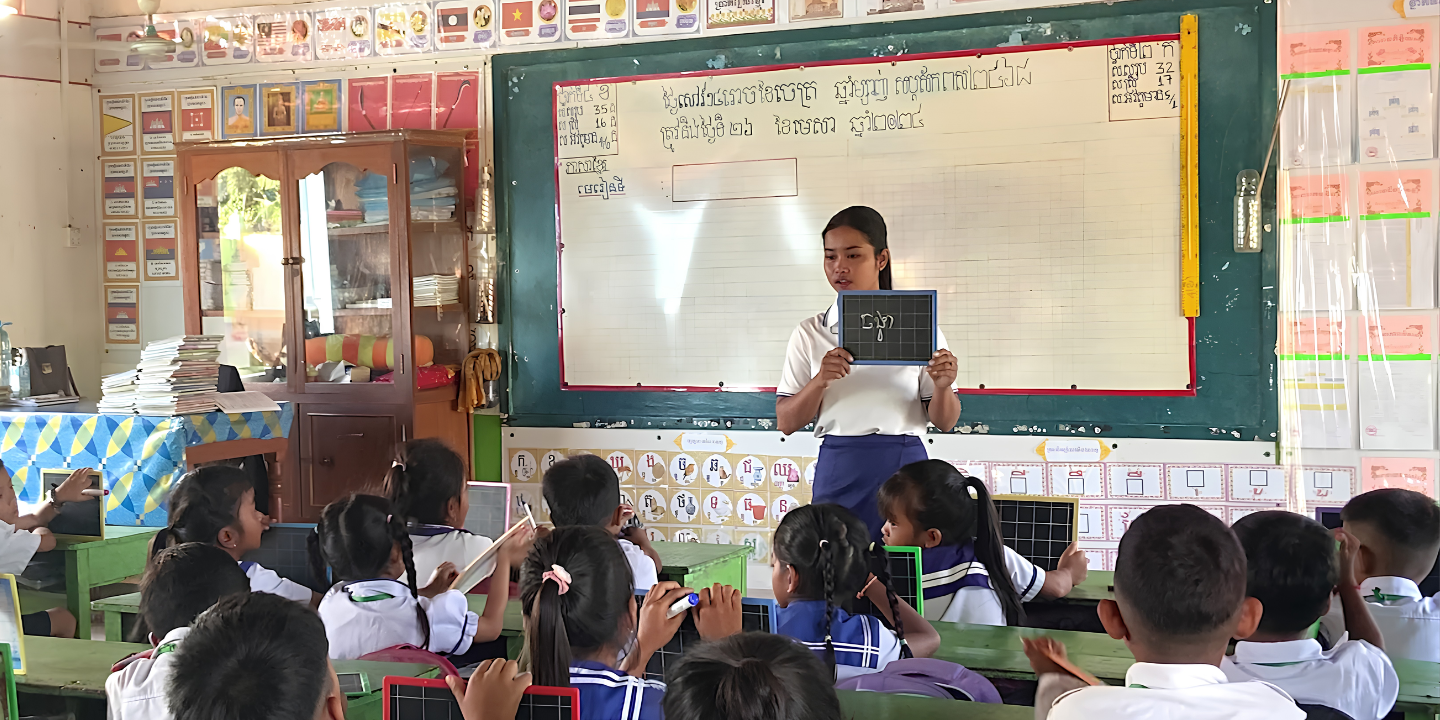
In 120 Grade 2 classrooms across 8 provinces, observers tracked how Khmer language lessons unfolded, capturing what teachers did, how students participated, and how time was spent on core early literacy skills. Part of the ASEAN-UK Supporting the Advancement of Girls’ Education (ASEAN-UK SAGE) Programme, the pilot was designed to provide practical, system-relevant evidence to support Cambodia’s planned scale-up of structured pedagogy through the Early Grade Learning (EGL) package for Grades 1–3.
As technical lead, ACER designed and delivered the Strengthening Monitoring and Evaluation Capacity for Foundational Learning Outcomes initiative. This involved building an approach that connected policy intent to what teachers and students experience in the classroom. Importantly, it also included generating insights to refine materials, strengthen professional learning and support effective implementation of the EGL package.
Working closely with MoEYS and coordinated in-country by SEAMEO TED, ACER developed tools tailored to Cambodia’s reform priorities. This included a time-event classroom observation tool and a materials evaluation tool for Grade 1–2 reading resources.
The British Council led a complementary lexical computing analysis of Grade 1–5 Khmer textbooks to examine language progression and whether high-frequency words are recycled often enough to support early reading fluency and comprehension. Together, these tools generated evidence across curriculum, materials and classroom practice, ensuring findings were both credible and actionable.
How the data was generated was as important as findings. ACER partnered directly with MoEYS technical departments, curriculum specialists and teacher training colleges. Officials co-designed tools, confirmed sampling, trained observers and material coders, and participated in joint analysis and reflection sessions. The pilot trained 80 observers, 8 material coders and established a lexical computing team within the Primary Education Department, embedding capability for ongoing evidence use.
Insights on early grade literacy
The study generated 6 system-level insights to inform priorities for strengthening early grade Khmer language literacy and improve structured pedagogy at scale:
- Oral language needs greater focus
Speaking and listening underpin early literacy but are underemphasised in both teaching and materials. Clearer expectations and practical activities could strengthen outcomes.
- Classroom interaction is mostly teacher-led
Whole-class instruction and parallel work are overrepresented, with fewer opportunities for pair and group work.
- Tasks are often choral or copy-based
Activities are often choral or copy-based, with few higher-order tasks. Expanding task types can increase cognitive demand while remaining age appropriate.
- Differentiation is intended but hard to enact
Teachers aim to meet diverse needs, but guidance is limited on using formative assessment and adjusting instruction in real time.
- High-frequency vocabulary need multiple and repeated exposure
Students encounter key Khmer words inconsistently and many low-frequency words are introduced, limiting the exposure children need to read, understand and use high frequency Khmer words fluently.
- Inclusion guidance is uneven
Gender participation is broadly balanced, but deeper gender-responsive strategies are inconsistent. There is limited guidance for learners with disabilities and for students whose first language is not Khmer.
Ultimately, the pilot shows structured pedagogy is reaching classrooms, and highlights where further gains can be made. Priorities include stronger classroom interaction and task design, clearer oral language routines, tighter sequencing of language in learning materials, and more practical guidance for inclusive teaching.
MoEYS is already using the findings to strengthen the EGL package through the Primary Learning Platform, including new student resources and professional learning modules, alongside targeted training to lift task-based instruction. Teacher training colleges are adopting the observation approach to support pre-service and in-service improvement. ACER continues to work with partners to link measurement, materials and teacher support so that scale-up matches classroom-level quality.
About the ASEAN-UK SAGE Programme
The ASEAN-UK SAGE Programme is the first project to be implemented under the ASEAN-UK Plan of Action (2022-26). The 5-year programme aims to support ASEAN member states to develop effective policies and programmes that improve foundational learning and tackle constraints limiting the achievement of girls, women and marginalised groups. The first phase of the ASEAN-UK SAGE Programme was delivered by British Council and SEAMEO Secretariat, in partnership with EdTech Hub and the Australian Council for Educational Research. ASEAN-UK SAGE is an ASEAN cooperation programme funded by the UK.