
TALIS 2024: Using data to support a vibrant and future-focused teaching profession
Research 13 Jan 2026 9 minute readEducators and school leaders recently joined a QRTA TALK hosted by the Queen Rania Teacher Academy (QRTA) in Jordan, with Dr Tim Friedman, Senior Research Fellow at ACER and Australia’s National Project Manager for the OECD’s Teaching and Learning International Survey (TALIS) 2024.
The session explored findings from TALIS 2024 and invited participants to a global conversation about the teaching profession, its evolving realities, and the opportunities available to better support teachers through evidence-informed decision-making.
The discussion was moderated by Dr Shadi Al Kholi, English Language Programs Lead at QRTA, and focused on how data can be used not only to understand teachers’ experiences, but also to strengthen professional environments and sustain the teaching workforce over time.
Giving teachers a voice through TALIS
TALIS is the world’s largest international survey of teachers and school leaders, amplifying their voices through reliable, comparative data. The 2024 cycle included responses from approximately 280,000 teachers across 17,000 schools in 55 education systems, including Australia, the UAE, Saudi Arabia, Bahrain and Morocco.
Dr Friedman opened the session by acknowledging the scale of participation behind the study and the teachers and school principals that participated in TALIS, whose contributions have enabled these rich findings.
When asked what message teachers are sending globally through TALIS, Dr Friedman highlighted the value of understanding both, what teachers care about and the conditions shaping their work.
‘We know that if we want to drive improvement in our students, teachers are really the most important way to do that,’ said Dr Friedman.
Teacher experience and support
TALIS data shows us that teachers across the Arabic-speaking countries tend to be earlier in their careers compared to the OECD average, reflecting strong recruitment into the profession. According to Dr Friedman, ‘many countries in the Middle East are doing a good job in recruiting new teachers’, but like many TALIS countries, there are ongoing challenges with perceived teacher shortages.
Dr Friedman noted that TALIS offers important insights into how systems can best support teachers during the initial years of their careers.
‘The report goes into detail about comparing teachers with different levels of experience,’ he explained. ‘Often, teachers earlier in their careers are working in more challenging contexts’, he added, including schools serving higher proportions of disadvantaged students.
TALIS data highlights the importance of systems that support novice educators, such as through induction and mentoring, and shows how these can help them build confidence, expertise, and resilience early in their careers.
Initial teacher education and professional learning
Across TALIS countries, teachers reported feeling well prepared by their initial teacher education in areas such as subject content, pedagogy and classroom practice. Notably, teachers in the UAE, Saudi Arabia, Bahrain and Morrocco rated the quality of their initial teacher education much higher than the OECD average.
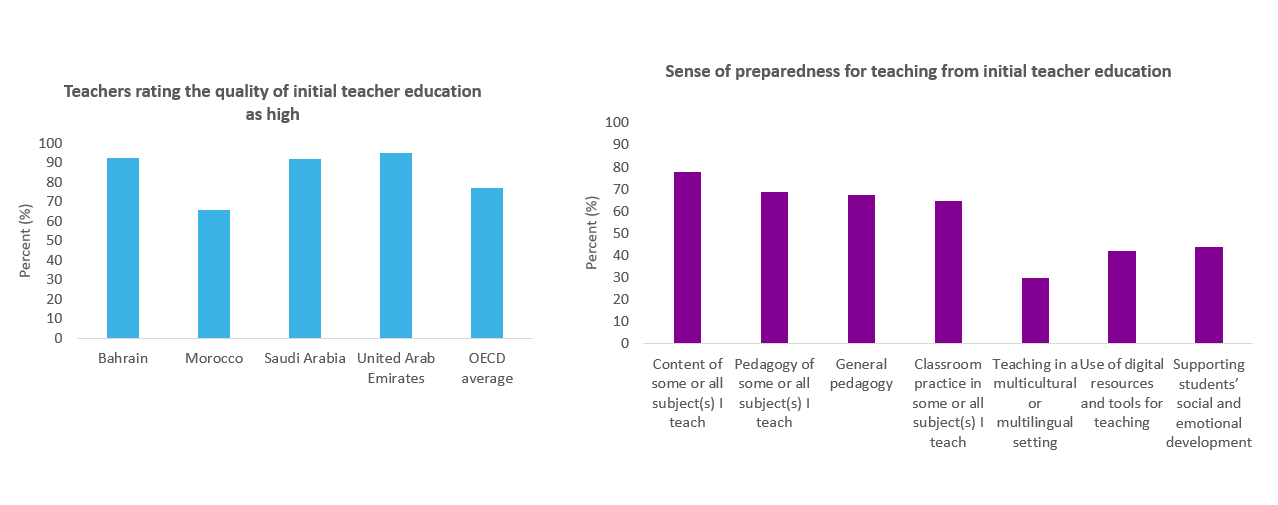
Where teachers reported feeling less prepared, both regionally and globally, was in teaching in multilingual and multicultural settings, using digital resources, and supporting students’ social and emotional development.
Professional learning remains a key lever for addressing these needs. TALIS shows that teachers in Arabic-speaking countries rated the impact of their professional learning more positively than teachers in many other participating countries.
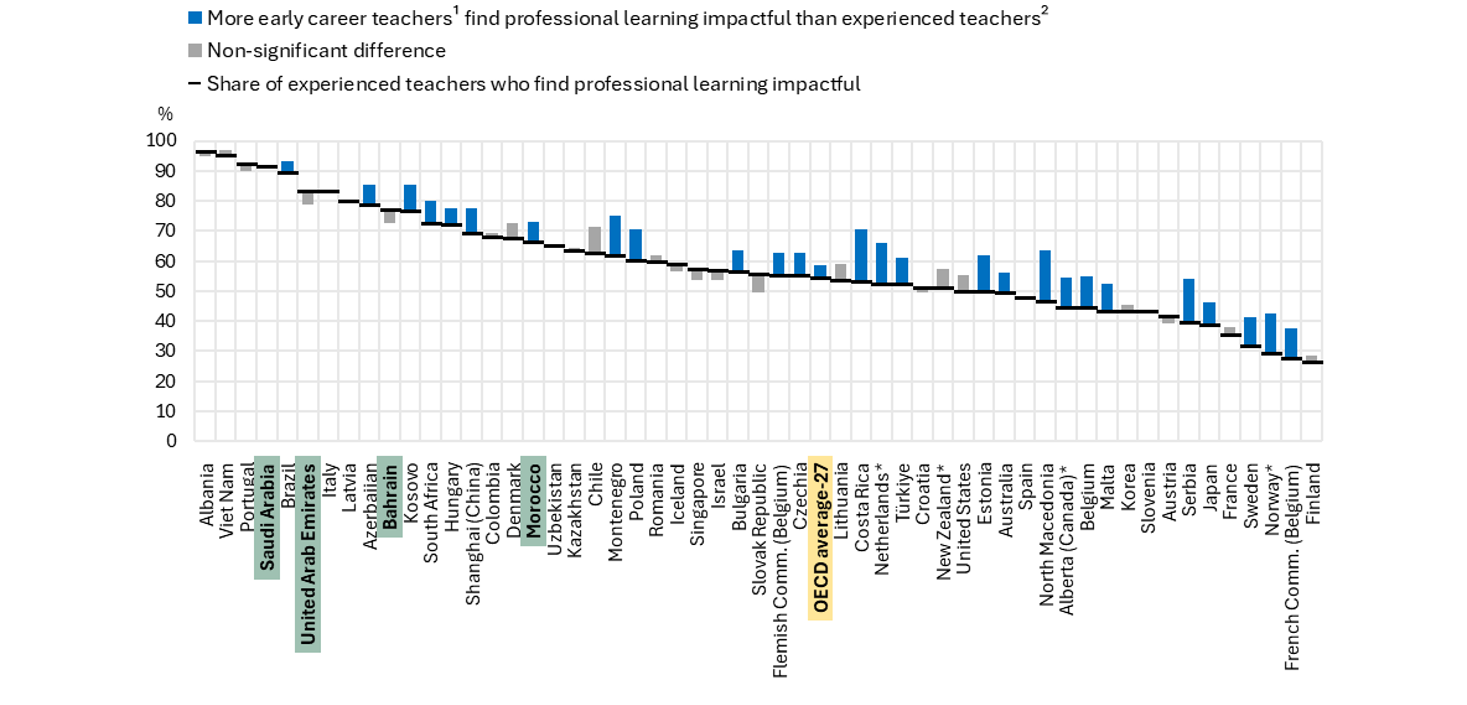
Dr Friedman emphasised that impact matters more than volume. ’Quality over quantity is important when it comes to professional learning,’ he said, noting the need to reduce barriers such as time constraints and to ensure learning is aligned with teachers’ needs.
Use of technology and AI in teaching
The session also explored teachers’ engagement with technology and Artificial Intelligence (AI). Around 40 per cent of teachers across OECD countries reported using AI, while teachers in the UAE stood out as the most ’prolific users of AI’, reporting the highest level of use among all participating countries, at close to 80 per cent. Saudi Arabia and Bahrain also reported higher-than-OECD average usage of AI.
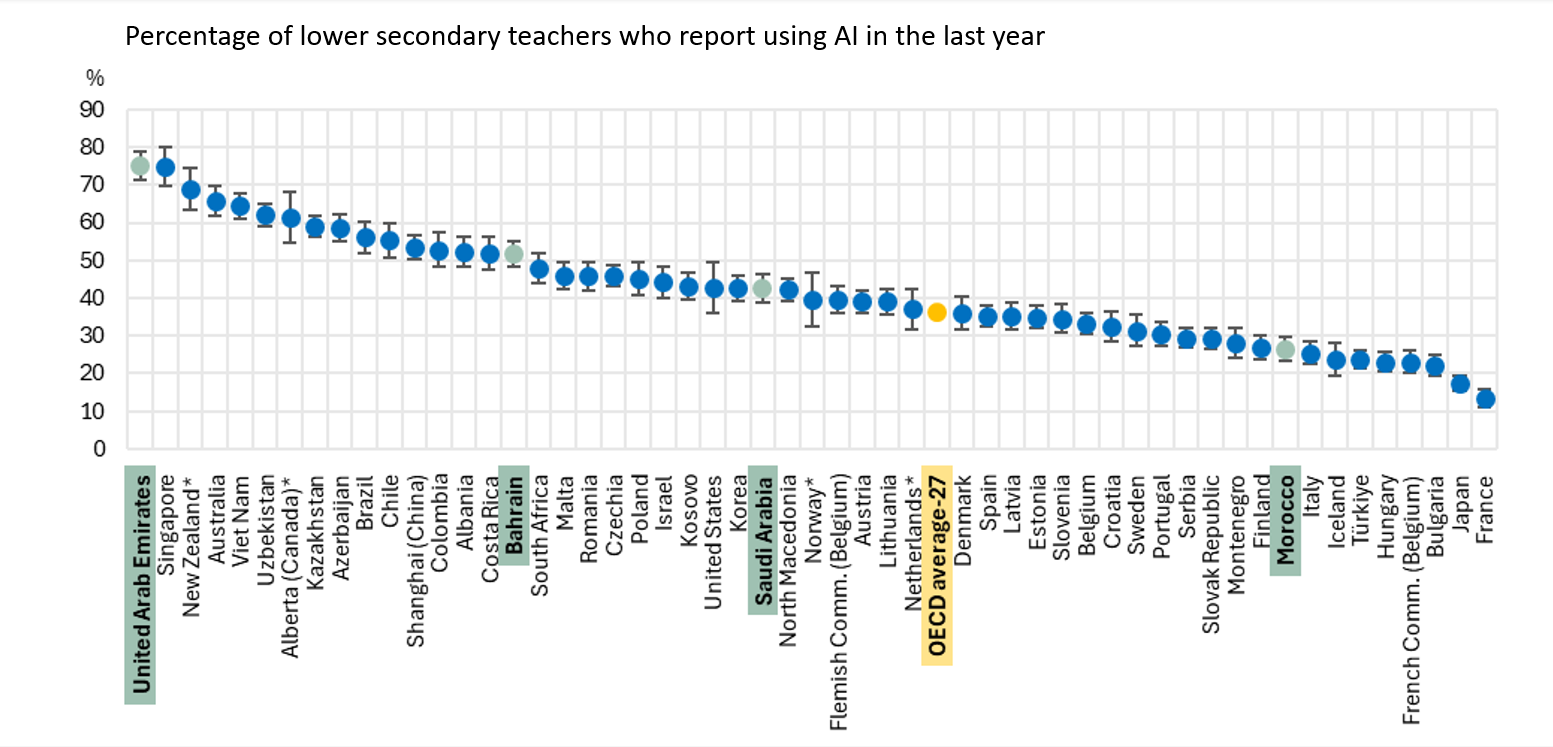

The most common uses of AI noted among teachers in the study, are to:
- learn about and summarise topics, and
- create lesson plans and learning activities.
Lower usage was reported for assessing or marking student work, or ‘reviewing student performance or participation in class’, reflecting a careful and considered approach overall.

Some of the notable barriers to using AI on average across the participating OECD countries are:
- they don’t feel they have the knowledge or skills to teach using AI,
- a lack of infrastructure in schools to use AI, and,
- feeling overwhelmed with integrating new technologies in their teaching.
‘Teachers are excited about the use of AI but are also being very mindful of how they are using it,’ Dr Friedman said. ‘They want to use it, but they don’t always feel they have the skills or knowledge yet’, he added.
Teachers also expressed a desire for clear guidance and safeguards, particularly around ethical use and potential risks.
Wellbeing, workload and professional relationships
TALIS 2024 highlights the central role of wellbeing and professional relationships in sustaining the teaching profession. Across countries, most teachers reported strong collegiality, with 86 per cent saying they could rely on colleagues at their school and noting high overall job satisfaction.
At the same time, TALIS identifies common sources of pressure, including administrative workload, marking and lesson preparation, keeping up with curriculum and program changes – or ‘change fatigue’, maintaining classroom discipline and being responsible for students’ academic achievement and social emotional development.
Just under half of teachers reported experiencing stress ‘quite a bit’ or ‘a lot’ in their work.
Encouragingly, TALIS shows that in systems such as the UAE and Saudi Arabia, the data reveals a decrease in stress among teachers over time.
Dr Friedman also highlighted the importance of leadership and feeling valued. ’Teachers want to be valued by policymakers,’ he said, and that moreover, ’Positive professional relationships with school leaders make a real difference.’
Turning evidence into action
Throughout QRTA TALK, Dr Friedman returned to the practical value of cross-country comparative data in TALIS as a tool for learning and improvement.
‘It enables us to learn from each other,’ he said, adding, ’People are always willing to share the challenges they’ve faced, and what they have done to address them’.
Drawing on TALIS 2024, the session highlighted practical ways schools and systems can use the findings.
What schools can do:
- monitor and manage administrative burden so it does not become overwhelming
- protect time for teaching, planning, marking and professional learning
- put induction, mentoring and collaboration in place, particularly for early-career teachers
- establish clear systems for the use of digital tools and AI, including practical classroom guidance.
What education systems can do:
- put appropriate wellbeing supports in place and be mindful of change fatigue
- support workforce stability by valuing teachers and providing targeted support where needs are greatest
- ensure professional learning is high impact, targeted and accessible
- provide up-to-date guidance and safeguards for digital and AI use
A shared commitment to professional growth
The themes explored during this QRTA TALK closely align with QRTA’s mission to elevate professional dialogue and empower educators and reflect ACER’s 95-year commitment to improving learning through high-quality research, assessment and evidence-informed practice.
Established in 2009, and in line with Her Majesty Queen Rania Al Abdullah’s vision, QRTA is a non-profit organization committed to supporting and empowering educators with the skills needed to nurture and lead future generations. QRTA offers innovative and evidence-based professional development programs informed by international best practices and the latest research in the field. Since its inception, QRTA has provided teachers and school leaders with professional learning opportunities and over 150,000 professional development opportunities across its various programs.
‘At Queen Rania Teacher Academy, we believe that empowering educators through evidence-based practices is key to shaping the future of learning. As part of a global education community, and through our partnership with ACER, we value TALIS 2024 insights as a foundation for strengthening teacher development and policy. By sharing knowledge and learning from international best practices, we aim to create sustainable solutions that truly meet teachers’ needs—turning data into action, supporting educators, strengthening schools, and advancing education across the region’, said Abdelmajeed Shamlawi, CEO, Queen Rania Teacher Academy
Continue the conversation
The QRTA TALK with Dr Tim Friedman demonstrated how TALIS 2024 data can inform thoughtful, practical action to support teachers and strengthen the teaching profession.