Youth voices in education: lessons from DevEd 2025
ACER news 22 Jan 2026 5 minute readInsights from DevEd 2025 demonstrate how youth participation and co-design are key to building inclusive, resilient education systems.
As the world marks International Day of Education on 24 January 2026, this year’s theme, ‘The power of youth in co-creating education,’ underscores a growing recognition that young people should play an active role in shaping the systems that serve them.
Youth under 30 make up more than half the global population. And yet, they are often overlooked in education decision-making. At a time of rapid technological and social change, their voices are vital to building systems that are inclusive, resilient and future-ready.
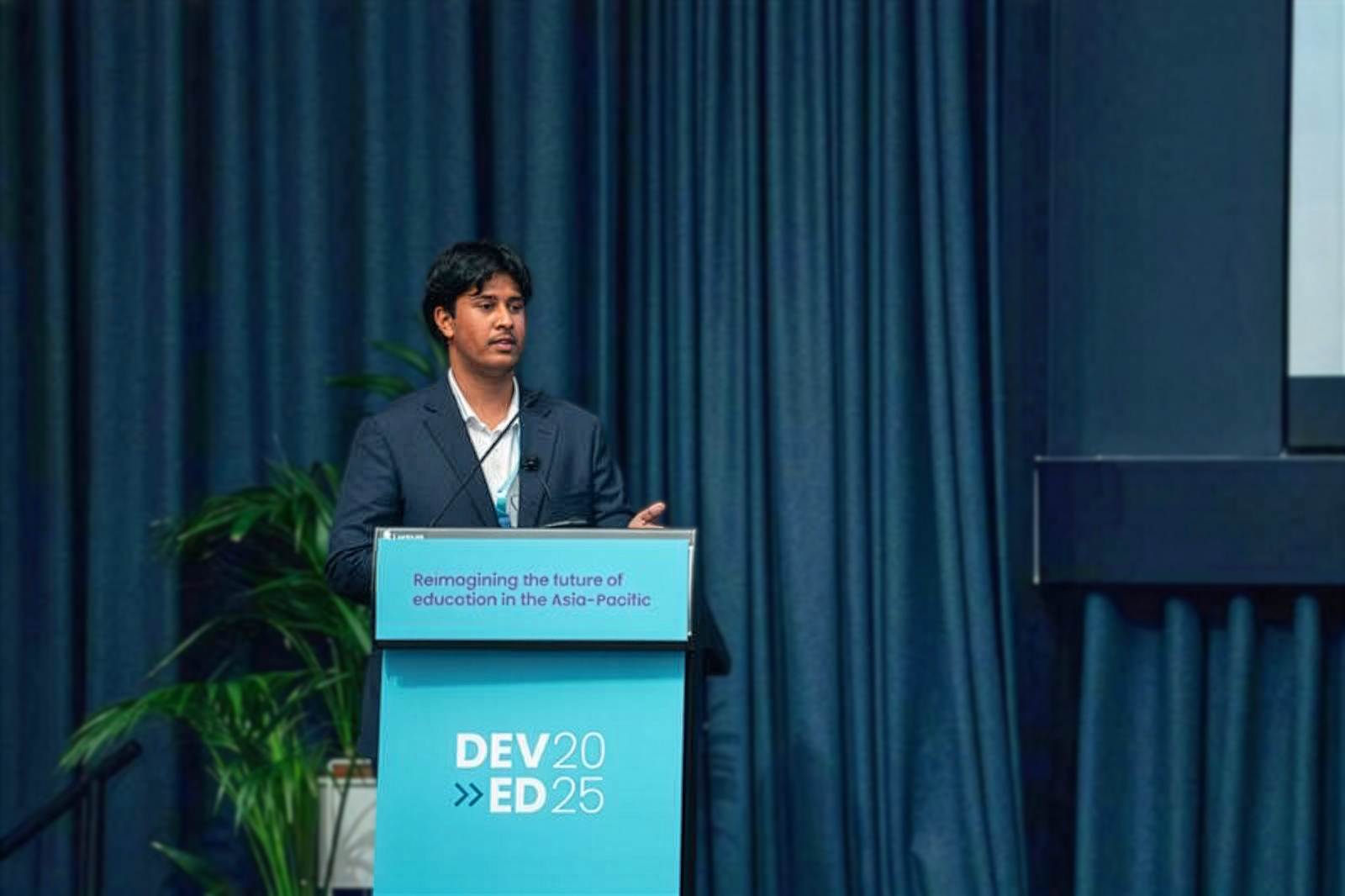
This message was reinforced at the inaugural Development and Education (DevEd) 2025 Conference co-hosted by the Australian Council for Educational Research (ACER), where Adriel Appathurai brought an important youth perspective to a standout panel on building resilient education systems. Chair of the Victorian Youth Division Committee and a medical student, Adriel’s contribution resonated strongly with participants and was widely regarded as one of the most impactful presentations of the 3-day event.
Adriel’s presentation was deeply personal. A refugee from Sri Lanka, he shared how education became a lifeline for his family amid conflict and disaster.
‘Education wasn’t just about marks – it was safety, it was belonging, and it was a way to break into this world,’' he reflected. ‘Coming from Sri Lanka to Australia, education was a way to make that happen.’
Adriel invited participants to consider how systems could better reflect the voices of young people.
‘Across this conference, we’ve heard about strengthening systems and what that may mean. But there’s a pattern I’ve noticed: that these systems are built for young people, they’re built for children. But, are they actually built with children and young people?’
Adriel highlighted examples of youth contributions during crises – translating warnings, organising community support – and suggested that similar collaboration could strengthen education. He argued for a shift from adult-led approaches to genuine co-design, where youth have equal voice and influence in shaping policy and practice.
‘Young people don’t have to be passive recipients, we can help out in education too. The shift I’m arguing for is simple: it’s that we move from adult-led models to truly co-designing systems with young people.’
Adriel outlined practical steps for inclusion, from mandating youth representation in policy, to funding youth-led innovation and creating feedback loops that show how input shapes outcomes. He also emphasised the importance of diversity: ‘There’s no one way to engage. What works best is having different pathways and different ways of engaging,” he noted in response to an audience question about representation.
As the global community prepares to celebrate International Day of Education, Adriel’s reflections highlight the need to move beyond tokenistic consultation and recognise youth as equal partners in shaping the future of learning. Education systems co-designed with young people are stronger, fairer, and better prepared for the challenges ahead.
More information
Watch Adriel’s full presentation in the panel session, ‘From exclusion to inclusion: building resilient education systems.’
Join our DevEd mailing list for updates about education and development in the Asia-Pacific region.